現有會員可[按此]登入。未成為會員可[按此]註冊。
[公司模式 - 關]  [懷舊模式 - 開
[Youtube 預覽 - 關]  [大字型]  [小字型]

您現在聚腳在 體育台內。

跳至第

發起人
[2025夏日跑步] GoDone Runners 討論區
325 個回應
夏天跑10K ~等如冬天15K以上
比人打完一獲咁:o)

yes. same feeling.


今日涼少少 都係濕哂


今朝落完雨去到球場又出太陽xx(


夏天跑10K ~等如冬天15K以上
比人打完一獲咁:o)

yes. same feeling.


今日涼少少 都係濕哂


今朝落完雨去到球場又出太陽xx(


落雨再蒸上黎好難頂
呢排成日係咁#ass#


報左台北馬 target sub330
自己pb係上次渣馬347
有冇可能:o)


400m standard track marking and Measurements
https://youtu.be/Syx75nz7UbM?si=oEeBxJwVCY8PO7td


夏天跑10K ~等如冬天15K以上
比人打完一獲咁:o)

yes. same feeling.


今日涼少少 都係濕哂


今朝落完雨去到球場又出太陽xx(


落雨再蒸上黎好難頂
呢排成日係咁#ass#

上星期跑機場。開揚。真係feel到蒸籠。


報左台北馬 target sub330
自己pb係上次渣馬347
有冇可能:o)

最近兩年半馬係?
渣馬347係2025?
10K PB係?


When I started running, I was a heel striker, with a flat feet, overpronate.

In this sense, I am "naturally a heel striker".

It has been quite a few years and I was trained to land on forefoot.

Nowadays, when I run faster, I tend to land on posterior side (outside) of my forefoot. Having that said, when I run slower, I tend to slap my entire feet to the ground, sometimes even in a posture resembling a heel strikering habit. Is this common?


今日跟左聰sir長課,熱到Hi Hi


今日跟左聰sir長課,熱到Hi Hi

今日跑均速25k 0630pace, 熱到 hihi :)fn


#bye# #bye# #bye#
無留意新POST


#bye# #bye# #bye#
無留意新POST

#bye# #bye# #bye#


Am I correct to suggest: running in hot weather or cold weathers spends extra energy?

If so, what is the optimal weather for running?

At what temperature do I have to exert extra power? Can you draw a chart for this?

============
How Temperature Affects Running Energy

Hot Weather

- Your body works harder to cool itself through sweating and increased blood flow to the skin.
- This diverts blood away from muscles, increasing heart rate and perceived exertion.
- Dehydration risk rises, which further reduces performance.
- Studies show that for every 1°C (1.8°F) above ~15°C (59°F), runners may slow down by 1–4 seconds per mile, depending on pace.


Cold Weather
- Your body expends more energy to maintain core temperature, especially below freezing.
- Muscles may become less efficient and stiffer, requiring more effort to move.
- Oxygen uptake can improve in cool air, but extreme cold (e.g. below -5°C or 23°F) can impair performance.

Optimal Temperature for Running

- The sweet spot for most runners is between 7°C and 15°C (44°F to 59°F).
- Elite marathoners often perform best around 10°C (50°F).
- Cooler temps reduce thermal stress, allowing your body to focus on movement rather than temperature regulation.

Performance Impact by Temperature
Here’s a simplified chart showing estimated performance impact based on temperature:
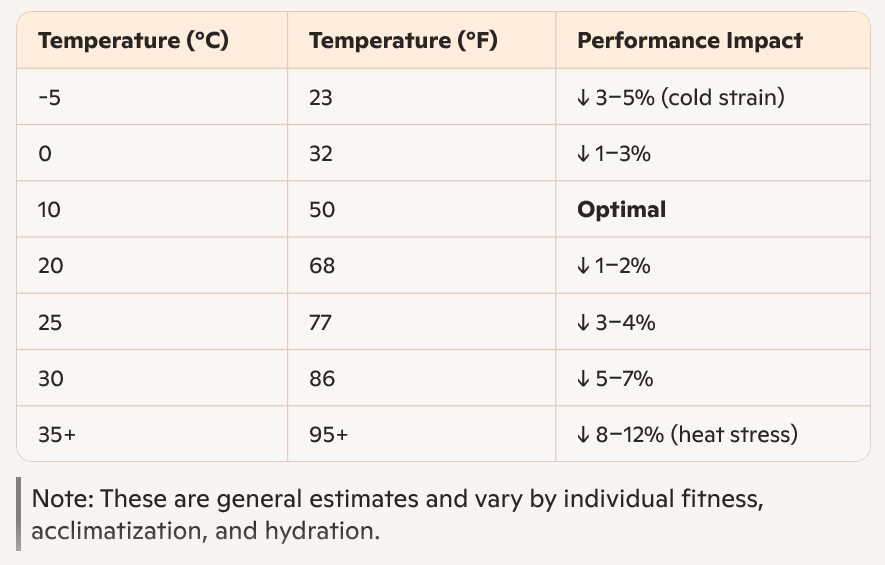
https://upload.hkgolden.media/comment/5ywdiamq.1xdi1mxaz0t.t3klvkwxcwu.jir.png


Cold Weather
- Your body expends more energy to maintain core temperature, especially below freezing.
- Muscles may become less efficient and stiffer, requiring more effort to move.
- Oxygen uptake can improve in cool air, but extreme cold (e.g. below -5°C or 23°F) can impair performance.

Optimal Temperature for Running

- The sweet spot for most runners is between 7°C and 15°C (44°F to 59°F).
- Elite marathoners often perform best around 10°C (50°F).
- Cooler temps reduce thermal stress, allowing your body to focus on movement rather than temperature regulation.

Performance Impact by Temperature
Here’s a simplified chart showing estimated performance impact based on temperature:
https://upload.hkgolden.media/comment/5ywdiamq.1xdi1mxaz0t.t3klvkwxcwu.jir.png

夏天,我真係唔理配速,只睇心跳就算。


報左台北馬 target sub330
自己pb係上次渣馬347
有冇可能:o)


交左成績同book左酒店, 不過重有d 1516唔知跑唔跑


今日跟左聰sir長課,熱到Hi Hi

今日跑均速25k 0630pace, 熱到 hihi :)fn


你地勁到 仲跑到咁長
今朝31度O:-)


今日跟左聰sir長課,熱到Hi Hi

今日跑均速25k 0630pace, 熱到 hihi :)fn


你地勁到 仲跑到咁長
今朝31度O:-)


成160分鐘,我而家都係得100分鐘[sosad]


今日跟左聰sir長課,熱到Hi Hi

今日跑均速25k 0630pace, 熱到 hihi :)fn


你地勁到 仲跑到咁長
今朝31度O:-)


成160分鐘,我而家都係得100分鐘[sosad]


都好勁[sosad]
我夏天長課完全要減半 xx(


Cold Weather
- Your body expends more energy to maintain core temperature, especially below freezing.
- Muscles may become less efficient and stiffer, requiring more effort to move.
- Oxygen uptake can improve in cool air, but extreme cold (e.g. below -5°C or 23°F) can impair performance.

Optimal Temperature for Running

- The sweet spot for most runners is between 7°C and 15°C (44°F to 59°F).
- Elite marathoners often perform best around 10°C (50°F).
- Cooler temps reduce thermal stress, allowing your body to focus on movement rather than temperature regulation.

Performance Impact by Temperature
Here’s a simplified chart showing estimated performance impact based on temperature:
https://upload.hkgolden.media/comment/5ywdiamq.1xdi1mxaz0t.t3klvkwxcwu.jir.png

夏天,我真係唔理配速,只睇心跳就算。

配速會更加練到嘢。可以減慢配速。又可以每跑1km \ 2km 飲水。


報左台北馬 target sub330
自己pb係上次渣馬347
有冇可能:o)

最近兩年半馬係?
渣馬347係2025?
10K PB係?

10k pb 46min 上年年尾
半馬 pb 1:46 2年前渣馬
更正 原來上次渣馬係 pb 3:45


報左台北馬 target sub330
自己pb係上次渣馬347
有冇可能:o)

最近兩年半馬係?
渣馬347係2025?
10K PB係?

10k pb 46min 上年年尾
半馬 pb 1:46 2年前渣馬
更正 原來上次渣馬係 pb 3:45

巴打同我岩岩相反 #hehe#
全馬你快過我
半馬10k我快過你

既然有耐力
夏天練習速度先?
咁330,10k應該 sub 45
耐力課照舊
但係加速度課
十月、十一月5k 10k會有答案。

事實上都合理
想跑 0455M pace
10k pace 0430


I feel my muscles very sore after running 25km under 35 degrees celcius, feeling as if I ran 35km in the winter. How come? I thought, whereas running in the heat, heat dissipation applies pressure on my cardio system, my muscle does not have to exert additional effort for the same pace.


Running 25km in 35°C heat can make your muscles feel as sore as running 35km in cooler conditions due to several physiological factors, even though you might expect the primary strain to be on your cardiovascular system. Here's why:

Increased Metabolic Stress: In high temperatures, your body works harder to regulate core temperature through sweating and blood flow to the skin for heat dissipation. This diverts blood away from working muscles, reducing oxygen delivery and increasing reliance on anaerobic energy production. This leads to faster accumulation of metabolites like lactate, which can contribute to muscle fatigue and soreness.

Dehydration and Electrolyte Imbalance: Running in 35°C likely caused significant sweating, leading to dehydration and loss of electrolytes (sohim, potassium, etc.). Even mild dehydration (2-3% body weight loss) impairs muscle function, reduces endurance, and increases perceived effort. Electrolyte imbalances can also cause muscle cramps or micro-damage, amplifying soreness.

Higher Perceived Effort and Muscle Strain: While your pace may have been the same, the heat increases your rate of perceived exertion (RPE). Your muscles may have worked harder to maintain that pace due to reduced efficiency from heat stress. This can lead to more microtears in muscle fibers, similar to what you'd experience with a longer run in cooler conditions.

Glycogen Depletion: Heat increases carbohydrate metabolism as your body prioritizes energy for cooling and muscle function. Faster glycogen depletion can lead to earlier muscle fatigue, making your muscles feel as though they’ve endured a longer effort, like a 35km run.

Inflammation and Recovery: Heat stress triggers a greater inflammatory response post-exercise, which can exacerbate delayed onset muscle soreness (DOMS). The combination of heat and prolonged exercise may also impair recovery due to added strain on your body’s systems.


Why Muscles Are Affected, Not Just Cardio

While heat does stress the cardiovascular system (higher heart rate, increased cardiac output), your muscles are not spared. The reduced blood flow to muscles, combined with dehydration and faster energy depletion, forces them to work under suboptimal conditions, leading to greater fatigue and damage than expected for the same pace in cooler weather.

Supporting Evidence

Studies, like those from the Journal of Applied Physiology (e.g., Nybo et al., 2014), show that exercise in heat increases muscle glycogen use and perceived effort, even at matched intensities. Dehydration studies (e.g., Sawka et al., 2015) also confirm that fluid loss impairs muscle performance and recovery, contributing to soreness.


Practical Takeaways

Hydrate Strategically: Aim to drink 500-1000ml of water with electrolytes per hour during hot runs, sipping regularly.

Adjust Pace: Expect a higher RPE in heat; slowing down slightly can reduce muscle strain.
Cool Down and Recover: Post-run cooling (e.g., cold water immersion) and rehydration can mitigate soreness.

Acclimatize: Gradual heat acclimation over 7-14 days can improve your body’s ability to handle hot conditions, reducing muscle and cardio stress.


跳至第


  快速回覆 - 輸入以下項目

本討論區現只接受會員張貼文章,本站會員請先登入。非會員人仕,您可以按此加入為新會員,費用全免,並可享用其他會員服務。


上次光臨時間: 20/6/2026 2:33
今天貼文總數: 611 | 累積文章數目: 7,501,560

聯絡我們 |  服務條款 |  私隱政策
Copyright © 2026 HKGolden.com. All Rights Reserved.